
Thoughtpiece, 21 September 2026
Blockchain’s moment for serious capital
For the first time in blockchain’s history, capital is lagging adoption.
 Ruud SmetsManaging Partner & CIO
Finance is moving onchain. Assets and financial functions such as exchange, lending, settlement, collateral and liquidity are moving into open protocols. The emergence of AI agents is set to accelerate this shift. Yet the protocols driving it remain almost entirely outside institutional portfolios.
Adoption has turned real
The first phase of blockchain was dominated by speculation. That was inevitable for a technology combining native capital formation with grassroots adoption. It damaged trust. It also funded the infrastructure.
That phase no longer defines the market. The GENIUS Act is law, and regulators are actively pushing forward market-structure rulemaking. Founders can build in the open. Institutions can engage.
Adoption shows up in the numbers. Stablecoin supply now exceeds $300 billion. Adjusted stablecoin transaction volume reached $8.8 trillion in the first half of 2026, compared with $10.8 trillion in all of 2025. Tokenized real-world assets outside stablecoins are approaching $40 billion.
Stablecoins are email for money: instant, global, programmable. Tokenization of equities, credit, bonds, commodities and funds is following. New native markets include perpetual futures, prediction markets and onchain credit. As assets move onto common infrastructure, liquidity and collateral trapped across institutions, geographies and asset classes can connect. Through blockchain protocols, the internet is becoming one global liquidity pool.
Regulation is finally unlocking distribution
For years, blockchain adoption was almost entirely grassroots, with little access to established financial distribution. This is now changing on the back of clearer regulation. Robinhood has provided a blueprint we expect others to follow: financial institution in the front, blockchain protocols in the back.
Robinhood, the $108 billion broker with 28.6 million funded customers, launched Robinhood Chain on July 1. Through it, eligible users can trade tokenized equities through Uniswap, earn yield through Morpho and trade perpetual futures through Lighter. Robinhood Chain is built using Arbitrum technology and ultimately settles on Ethereum. Robinhood reported 28.6 million funded customers at the end of August.
The novelty? Robinhood keeps the customer relationship, distribution and access to its regulated products, while open, internet-based protocols provide the financial functions underneath.
These protocols operate globally, 24/7 and are composable with one another. Instead of every institution rebuilding and controlling the entire financial stack, Robinhood can plug into shared financial infrastructure.
“Through blockchain protocols, the internet is becoming one global liquidity pool.”
The traction speaks for itself. In its first two months, more than $40 billion was traded across spot markets and perpetual futures on Robinhood Chain. Uniswap, which had grown for years almost entirely through grassroots adoption, suddenly saw Robinhood Chain become roughly half of its protocol revenue. The protocols were already there. What changed was distribution.
This is before Robinhood has meaningfully turned on its real distribution advantage. Its own app users account for only around 1 to 2 percent of transactions on the chain to date. Most activity has instead come from crypto-native users, trading applications and market makers. In other words, the protocols are already seeing this level of activity before Robinhood has really opened the funnel to its 28.6 million funded customers.
For Robinhood, the economics are equally compelling. Instead of building every financial service itself, it can connect customers to existing infrastructure and participate in the economics. Less than three months after launch, Robinhood Chain is approaching $50 million in cumulative gross fee revenue and more than $40 million in profit for Robinhood. The model is still very early, but its economics are already becoming visible.
Robinhood equity is widely held by institutions. The underlying protocols are not. That is the investment anomaly. Institutions are gaining exposure to the companies distributing onchain finance, while largely missing the infrastructure those companies increasingly rely on.
The market is beginning to recognize the difference. As the chart below shows, since Robinhood Chain launched on July 1, the protocol tokens powering its infrastructure have significantly outperformed Robinhood’s own shares. Yet these tokens remain almost entirely outside institutional portfolios.
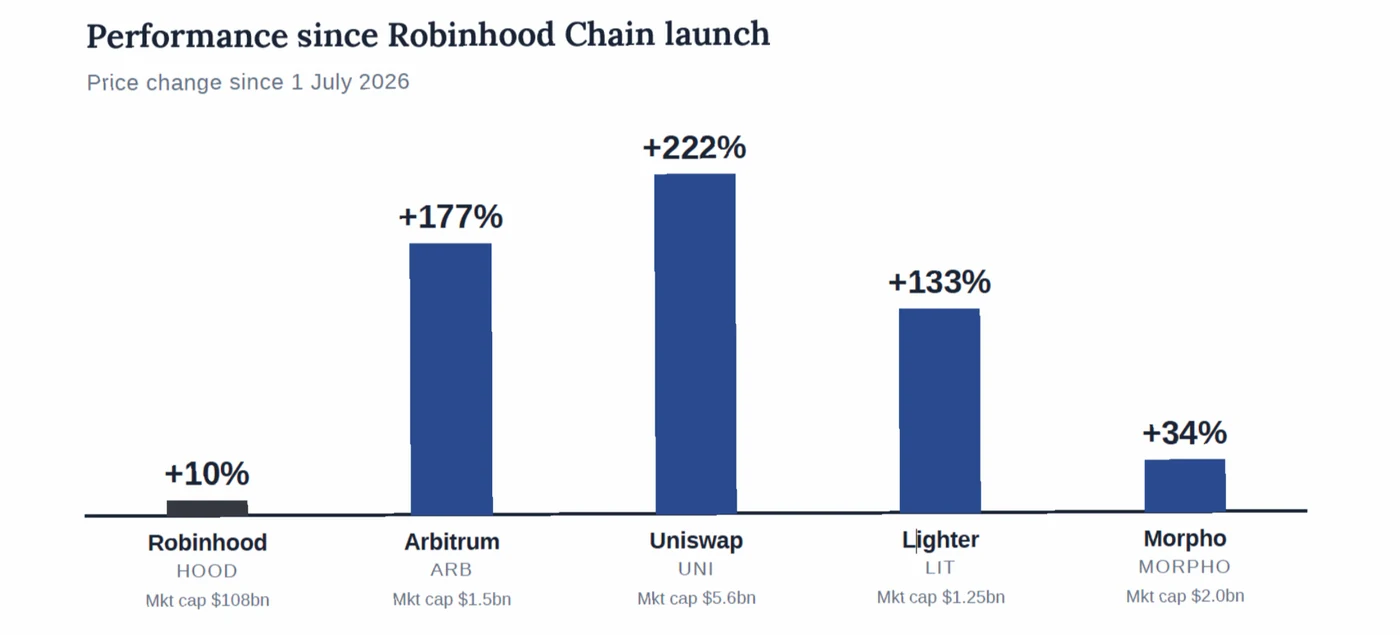
That is beginning to change. Regulatory clarity is improving, protocol revenues are becoming more explicit, and some of the institutions closest to the infrastructure are starting to invest directly.
Robinhood itself invested in Lighter. BlackRock bought UNI tokens as it brought its BUIDL fund onto Uniswap. Apollo agreed to acquire up to 90 million MORPHO tokens over four years, taking direct economic exposure to the lending protocol it is increasingly using.
The institutions at the forefront of using this infrastructure are also among the first to recognize that the protocols themselves can be investable assets.
Protocol traction was already becoming visible well before Robinhood Chain launched. Hyperliquid is the clearest example of what a protocol-native financial business can become.
In just 21 months, it has generated more than $1.2 billion in cumulative protocol revenue, with roughly 99 percent of core trading fees used to buy HYPE in the market and remove it from circulation, economically similar to a continuous stock buyback.
The point is not Hyperliquid specifically. It is that protocols are already moving from experiments to financial infrastructure with real users, revenues and increasingly explicit economics, while institutional ownership remains minimal.
AI agents: a new class of financial actor
Finance is already moving onchain. Now a second force is arriving that could materially accelerate it.
AI agents are moving from generating information to initiating economic activity. They can discover services, allocate capital and transact within rules set by people or organizations. They need infrastructure built for software: global, always available, programmable and accessible through code.
Public blockchains provide that architecture. Stablecoins give agents native digital money. Smart contracts make rules executable. Open protocols provide exchange, lending, collateral and settlement.
AI is not the reason finance is moving onchain. But it could become a powerful accelerator.
The conviction
Every payment, every financial transaction today moves through a web of intermediaries, each introducing costs, friction and boundaries. Blockchain reduces this to direct transactions coordinated by open protocols. It removes the need for trusted intermediaries, makes settlement continuous, makes ownership digital and composable, and allows applications to connect to financial infrastructure without asking permission from a bank, a broker, a custodian or a payment company. It is highly disruptive.
You can build infrastructure that no one controls, that everyone can use, and that you can still own a piece of. That combination does not exist elsewhere.
“You can build infrastructure that no one controls, that everyone can use, and that you can still own a piece of. That combination does not exist elsewhere.”
The early years were noisy. The industry overpromised. Too many projects had no reason to exist, and too many tokens were attached to weak products. The skepticism is earned.
The next phase is different. The infrastructure works, usage is real, revenue is visible, the regulatory path is opening, and institutional capital is moving.
We are still extremely early. General-purpose public blockchains are just over a decade old. The technology has only been broadly usable for a few years. Real adoption has barely begun. This is still the zero-to-one moment. Full adoption will take decades.
At some point, blockchain stops being a speculative corner of markets and starts being financial infrastructure. When that happens, the speculative years will be no more than a blip on the adoption chart.
This is the moment for serious capital.